The “Roman Room” method, also called the method of loci, turns a list into an imagined walk. Choose a familiar place, pick a sequence of landmarks, and connect each item with a vivid image at one location. To recall the material, mentally retrace the same route and collect the images in order.
Where the name comes from
People also call the technique a “memory palace,” but you do not need an actual palace. Book III of Rhetorica ad Herennium, an ancient Latin rhetoric handbook whose author is unknown (it is no longer attributed to Cicero), describes using places and images as aids to artificial memory. The practice belongs to the ancient rhetorical tradition; there is no single confirmed inventor.
Build a memory route step by step
- Choose a familiar place. Use your home, a route to a nearby stop, or a building you know well. Start somewhere you can picture without a map.
- Set one direction. Decide where the walk starts and what comes next: front door, hallway, kitchen, window, balcony.
- Pick distinct landmarks. Use stable points such as a doormat, mirror, table, or door handle. Five to ten locations are enough for a first practice run.
- Make an image for each item. Link it to an object, action, or playful scene and place that image at one specific landmark. Unusual, vivid images are easier to notice as you walk through the route in your mind.
- Revisit and retrieve. Walk the route once after placing the images, then try recalling the list later without looking. If the order slips, make the landmarks more distinct or simplify the image.
Example: a short shopping list
Imagine walking from your front door to the kitchen. A huge loaf of bread blocks the doormat; a lemon replaces your reflection in the mirror; a kettle spills tea across the kitchen table; an apple rolls beside the window. To recall the list, return to the door and visit each landmark in turn. Abstract ideas can also become concrete images: make a term into a sign, a process into a short scene, or an argument into an object that changes.
What it can help with—and its limits
The method adds order and spatial cues to material that might otherwise remain a flat list. Studies of method-of-loci training show that people can learn to recall sequences more effectively, but outcomes depend on practice, material, and how recall is measured. The technique cannot guarantee that everything will stick, does not replace understanding, and takes time to build images. For studying, combine it with explaining ideas in your own words, spaced review, and self-testing.
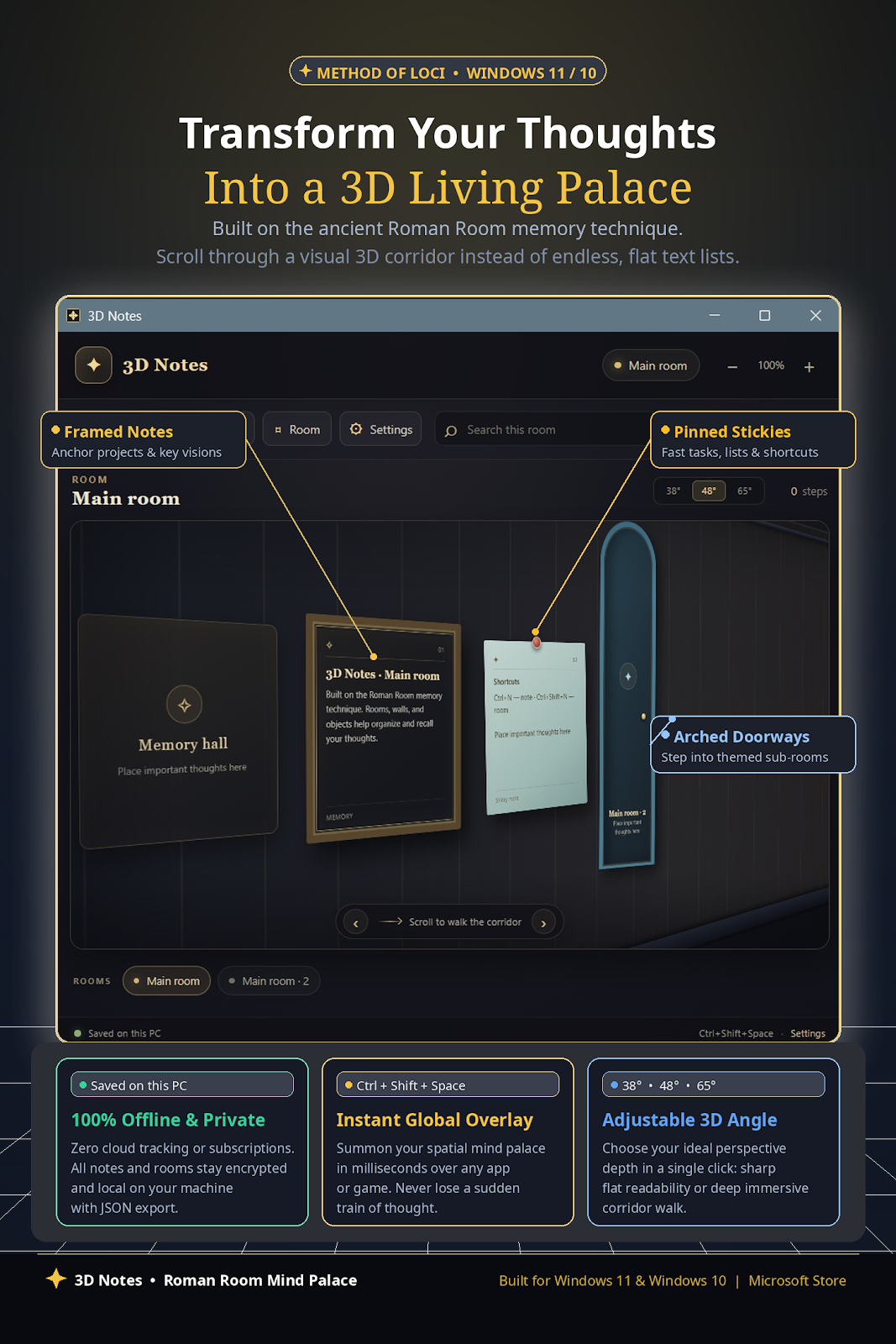
A digital space can help you arrange ideas into rooms. Notes 3D — A Visual Memory Space for Windows is a visual note-taking app with rooms and a corridor, inspired by the method of loci. It is not a dedicated memory-training program. Notes are stored on your computer, and you can move backups in JSON format.
Sources and further reading
- Rhetorica ad Herennium, Book III: places and images in the account of memory.
- A study of method-of-loci training and durable recall (2021).
- A systematic review and meta-analysis of method-of-loci research; the authors note that findings vary across studies.
See the app interface